
Best boat for most people
There is no off-season for whale watching in Tenerife: several hundred short-finned pilot whales live in the channel all year, and operators report sightings on about 99 % of trips. What changes is the sea and the light — 19.2 °C in the coolest month and 23.8 °C in the warmest, 10.6 hours of daylight in January against more than 13 in summer, trade winds strongest in July and August, calima haze most often in January and February. The calmest water is September–October.

Best boat for most people

Ninety minutes, cheapest proven

Lunch and pickup, no car needed
If you can choose, September and October are the best time for whale watching in Tenerife: the sea is at its warmest (23.8–23.7 °C), the trade winds that roughen the afternoons in July and August have eased, and the summer crowds have gone. The pilot whales are no more likely than in any other month — they are resident — but the ride is calmer and the swim stop warmer.
Spring is the time for variety: Atlantic spotted dolphins and Bryde's whales are reported most often from March to May, and sperm whales are seen occasionally from autumn to spring. Winter brings the fewest boats and some migrating baleen whales, at the cost of cooler water, shorter days and the odd day of calima haze.
Whatever the month, book a morning departure if you are prone to seasickness: the north-east trade wind usually picks up after midday, and the south-west coast is calmest early.
Winter (December–February): sea 21.2–19.4 °C, the shortest days of the year, few boats and quiet marinas; calima episodes are longest in January and February. Carnival is in Santa Cruz, in the north-east, well away from the whale-watching ports.
Spring (March–May): the sea is at its coolest (19.2 °C in March), days lengthen fast and spotted dolphins peak. Summer (June–August): 23.1 °C water, sunsets after 20:45 and the strongest trade winds — the busiest boats of the year.
Autumn (September–November): the calmest and warmest sea of the year, with 23.7 °C in October; clocks go back at the end of October and sunsets move from about 20:13 to 18:16. Our month pages give every number for every month.
sailboat★ 4.92,265 reviews“Super welcoming, warmhearted and mindful guides! We really recommend this tour with Eileen, David and Jaime! Private atmosphere, knowledge, good food and drinks and they really care about the environment and the guests a”
eco yacht★ 4.719,265 reviews“We saw pilot whales and sea turtles so amazing. There was shade and enough seats for everyone to see. When we went for a swim it was easy to get back on the boat with their good ladder. The trip was great.”
catamaran★ 4.82,213 reviews“the little children were a little bit loud bit the crew was top, i'm looping for apotheek trip with the same crew this week”
All 72 boats: cancel up to 24 hours before the start for a full refund.
source · partner listingsEco-yachts built with a low centre of gravity are the steadiest; mornings and September–October are the calmest water.
source · operator listings · AEMETLicensed boats keep 60 m from the animals and nobody enters the water near them. The swim stop is a cove afterwards.
source · Decreto 178/2000About 24 noticeable days a year, longest in January–February. Visibility drops but trips still run.
source · AEMETSwimwear, a towel, sunscreen, a hat and a light layer for the run out.
source · operator listingsJanuary: sea 20.1 °C, air 21.7 °C, 1.8 rain days, sunset 18:35 — trade winds lighter than in summer. February: sea 19.4 °C, air 22.0 °C, 2.2 rain days, sunset 18:58 — much like January: light trades, the coolest sea of the year and the occasional calima day. March: sea 19.2 °C, air 23.1 °C, 1.9 rain days, sunset 19:15 — moderate trade winds. April: sea 19.6 °C, air 23.1 °C, 1.1 rain days, sunset 20:33 — steady trade winds. May: sea 20.4 °C, air 23.9 °C, almost no rain, sunset 20:50 — trade winds building. June: sea 21.5 °C, air 25.4 °C, almost no rain, sunset 21:06 — north-east trades strengthening, with stronger afternoons.
July: sea 22.2 °C, air 27.7 °C, almost no rain, sunset 21:06 — the windiest month with August. August: sea 23.1 °C, air 28.4 °C, almost no rain, sunset 20:47 — the windiest month with July and the hottest air. September: sea 23.8 °C, air 27.9 °C, 0.6 rain days, sunset 20:13 — the trades ease. October: sea 23.7 °C, air 26.8 °C, 1.6 rain days, sunset 19:39 — calm, light winds. November: sea 22.6 °C, air 24.8 °C, 1.9 rain days, sunset 18:16 — the first winter fronts and swell are possible. December: sea 21.2 °C, air 22.8 °C, 3.5 rain days, sunset 18:14 — the wettest month, still only about 3.5 rain days.
Short-finned pilot whale: resident — several hundred (IMMA); seen all year — seen on most trips (operator data); Bottlenose dolphin: resident; seen all year — frequent (operator data); Atlantic spotted dolphin: seasonal visitor — peak Mar–May; seen spring, occasional all year — common in season (operator data); Striped dolphin: occasional; seen all year — occasional (operator data).
Risso’s dolphin: occasional; seen all year — rare (operator data); Sperm whale: occasional, deep water; seen autumn, winter and spring (Sep–Apr, operator data) — rare (operator data); Bryde’s whale: occasional — peak Mar–May; seen spring, occasional all year — rare (operator data); Fin whale: seasonal visitor — migrant; seen winter–early spring — rare (operator data). All of it is operator data; the only census figure is the resident pilot-whale population of about 362.
There is no bad month for the whales. Pick the month for the rest: the warmest sea is in September (23.8 °C), the coolest in March (19.2 °C); July and August are the windiest, September and October the calmest; spring brings the spotted dolphins. Each month has its own page with the numbers and the boats to book.
How we compare: every number here comes from the GetYourGuide listings as we read them on 23 Sep 2026 — price, duration, what is included, the rating and the number of reviews — and from public sources we name next to the figure. We rank by rating only among boats with a hundred reviews or more, because a ★ 5.0 from three reviews says little. Where a listing does not state something, we say so instead of guessing. We earn a commission on bookings; it is the same for every boat and does not decide the order.
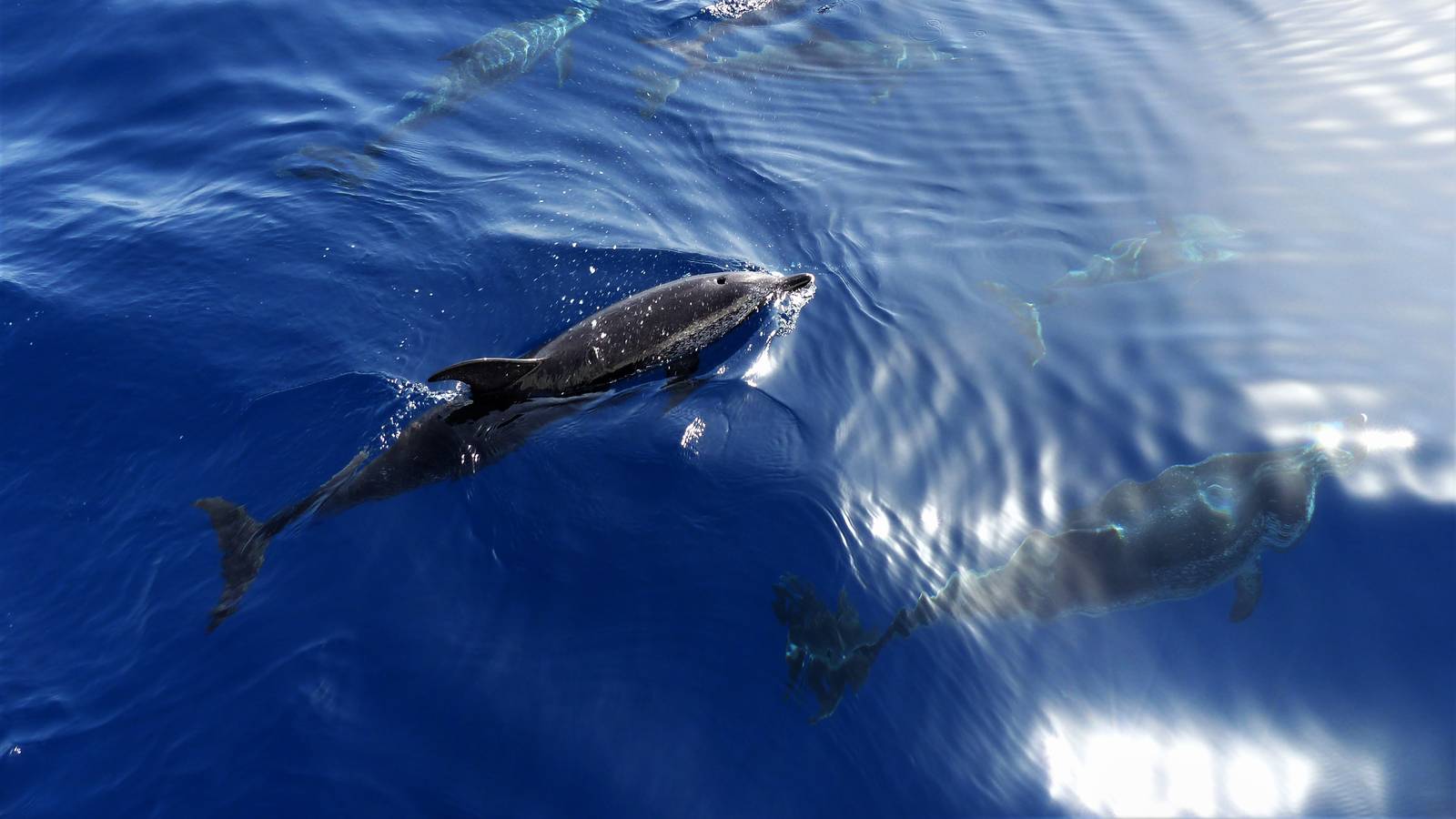
Any month for the whales; September and October for the calmest, warmest sea; December to February for the fewest boats; March to May for spotted dolphins.
No — pilot whales and bottlenose dolphins are resident all year. Seasonal visitors such as spotted dolphins, Bryde's and fin whales add to the list in spring and winter.
The trade winds peak in July and August, and afternoons are choppier. Morning departures and the eco-yachts are the calmer choice.
Saharan dust haze. AEMET counts about 24 noticeable calima days a year, longest in January and February; trips run, but visibility drops.
From about 19.2 °C in late winter to 23.8 °C in September–October — the swim stop is warmest from July to November.
Yes — the pilot whales are resident, and winter adds the chance of migrating baleen whales. The water is cooler and the days shorter.