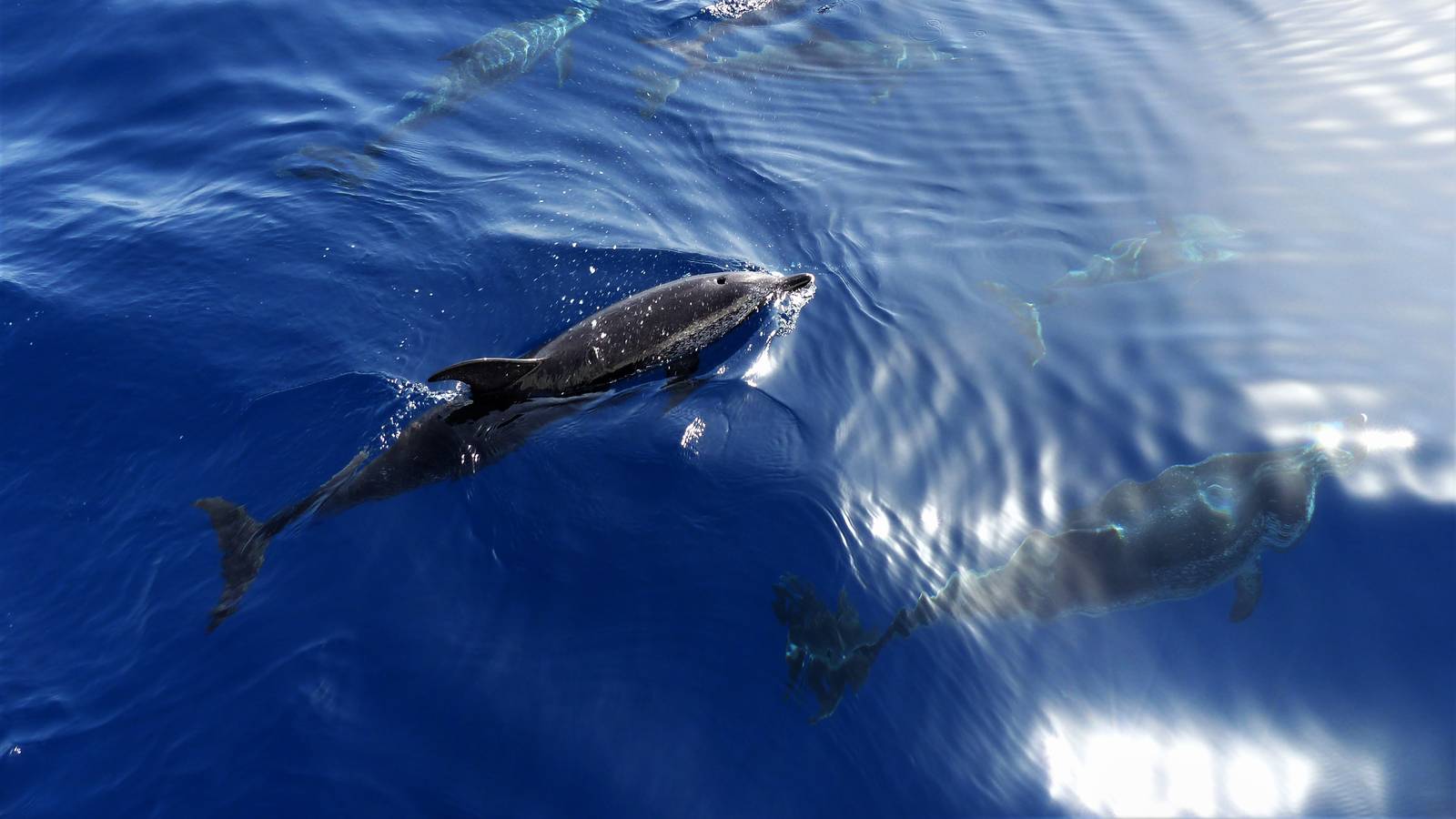
Ninety minutes, cheapest proven
Every licensed whale watching boat in Tenerife must fly the yellow Barco Azul flag and follow Decreto 178/2000: no closer than 60 m, no more than 2 boats within 100 m of a group and 3 within 500 m, no more than 30 minutes with a group, 4 knots nearby, and nobody in the water with the animals. The waters between Tenerife and La Gomera have been Europe's first Whale Heritage Site since 27 January 2021. Two eco-yachts from Los Cristianos go further, with smokeless, low-emission engines.

Ninety minutes, cheapest proven

No-chase catamaran, 90 min

Best boat for most people
A licensed boat may not come closer than 60 metres to the animals; no more than two boats may sit within 100 metres of a group and no more than three within 500; a boat stays with a group for at most 30 minutes and moves at 4 knots or less nearby; nobody enters the water near the whales. The swim stop you are sold is a cove afterwards.

Two eco-yachts from Los Cristianos run smokeless, ultra-low-emission engines and were designed for whale watching; the low centre of gravity also reduces seasickness. A sea kayak tour from the same coast is the lowest-impact way onto the water, but it is not a whale watching tour and does not carry the flag — we mention it once and do not list it.
The eco-yacht that sails from Los Cristianos is the only boat on the island its operator describes as designed specifically for whale watching rather than converted from another use. It runs smokeless, ultra-low-emission engines, has a low centre of gravity that reduces rolling, and carries a specialist guide. It sails 90-minute trips during the day (★ 4.7 from 19,265 reviews) and a sunset departure (★ 4.6 from 2,293 reviews), from €29.90 and €29.90.
Low emissions matter here because the pilot whales rest near the surface between dives; a quieter hull and less exhaust are easier on them and on you. The trade-off is size: up to 70–80 people aboard.
The no-chase catamaran from Los Cristianos (★ 4.6 from 15,307 reviews) sells itself on a promise every licensed boat should keep: approach slowly, wait for the animals, never cut across their path or follow them. It adds underwater viewing below the waterline.
Chasing is already illegal under Decreto 178/2000 — boats must slow to 4 knots within 500 m, avoid abrupt changes of course within 60 m and leave after 30 minutes. What varies between operators is how strictly they keep it; reviews that mention boats crowding the animals are worth reading before you book.
See the no-chase catamaranAn ethical trip in Tenerife looks like this: a yellow Barco Azul flag on the mast, the engine throttled back as the boat approaches, no more than two boats near the same group, a guide who explains what you are seeing, and a swim stop well away from the animals. If a boat promises swimming with dolphins, it is breaking the law.
The area's protection goes beyond the decree. The Teno-Rasca marine strip is a special area of conservation (ZEC) of 69,490 ha, and the Tenerife–La Gomera marine area was declared Europe's first Whale Heritage Site on 27 January 2021 — a label that recognises responsible whale watching as part of the local economy.
A sea kayak trip from the same coast is the quietest way onto the water, but it is not a whale watching tour and does not carry the flag; we mention it and do not list it.
See the sailboat
eco yacht★ 4.719,265 reviews“We saw pilot whales and sea turtles so amazing. There was shade and enough seats for everyone to see. When we went for a swim it was easy to get back on the boat with their good ladder. The trip was great.”
catamaran★ 4.615,307 reviews“We saw whales and dolphins and the crew helped us spot them. It was a great trip.”
sailboat★ 4.92,265 reviews“Super welcoming, warmhearted and mindful guides! We really recommend this tour with Eileen, David and Jaime! Private atmosphere, knowledge, good food and drinks and they really care about the environment and the guests a”
All 72 boats: cancel up to 24 hours before the start for a full refund.
source · partner listingsEco-yachts built with a low centre of gravity are the steadiest; mornings and September–October are the calmest water.
source · operator listings · AEMETLicensed boats keep 60 m from the animals and nobody enters the water near them. The swim stop is a cove afterwards.
source · Decreto 178/2000About 24 noticeable days a year, longest in January–February. Visibility drops but trips still run.
source · AEMETSwimwear, a towel, sunscreen, a hat and a light layer for the run out.
source · operator listingsTen of the 72 listings use the words eco, respectful or no-chase in their title, includes or highlights: Travelin' Lady: Eco Yacht Whale & Dolphin Safari + Swim (★ 4.7 from 19,265 reviews), Eco No-Chase Respectful Whale & Dolphin Encounter (★ 4.6 from 15,307 reviews), Whale & Dolphin Eco-Cruise with Snacks & Drinks (★ 4.6 from 5,795 reviews), Whale-Watching Cruise & Swim from Los Cristianos (★ 4.7 from 4,243 reviews), Sunset by Travelin´ Lady: Eco Yacht Whale Watching (★ 4.6 from 2,293 reviews) and Los Gigantes Whale-Watching Cruise with Lunch (★ 4.4 from 711 reviews) and four more.
The label is the operator’s; the rules are the law. Under Decreto 178/2000 every licensed boat keeps 60 m from the animals, no more than 2 boats within 100 m and 3 within 500 m, stays at most 30 minutes with a group and slows to 4 knots near them. A boat that promises not to chase them is promising what the law already requires — the difference is in how the crew behaves, which reviews show better than titles.
We read the most recent reviews of each boat that sell an eco approach — 34 in all, written between 26 Dec 2025 and 20 Sep 2026, averaging ★ 5.0. 18 mention whales, 15 mention dolphins, 4 mention turtles, 17 mention the crew or the guide, 1 mention the food or drinks, 1 mention the swim, 1 mention seasickness and 1 mention waiting or a late start. Seasickness comes up in one of them — worth taking seriously if you are prone to it; the steadiest boats are the eco-yachts and the catamarans. This is a sample of the latest reviews, not the whole record; the rating next to each boat covers every review.
Where they leave from: four from Los Cristianos (about 25 minutes to deep water), three from Costa Adeje (about 25 minutes to deep water) and three from Las Galletas (about 35 minutes to deep water). The port decides the run to the whales and how you get there; the whales themselves are the same off the whole south-west coast.
How we compare: every number here comes from the GetYourGuide listings as we read them on 23 Sep 2026 — price, duration, what is included, the rating and the number of reviews — and from public sources we name next to the figure. We rank by rating only among boats with a hundred reviews or more, because a ★ 5.0 from three reviews says little. Where a listing does not state something, we say so instead of guessing. We earn a commission on bookings; it is the same for every boat and does not decide the order.
On a licensed boat, yes: the Canary Islands regulate distance, numbers, time and speed under Decreto 178/2000, and the area is Europe's first Whale Heritage Site.
It flies the yellow Barco Azul flag, 80 × 50 cm, with two whales on it. If you do not see the flag at the pier, ask before you board.
No — swimming, diving and feeding within 500 m of the animals are forbidden. The swim stop is a cove afterwards.
The eco-yacht from Los Cristianos, with smokeless, low-emission engines and a hull built for whale watching; sailboats that switch the engine off are the other quiet option.
A label from the World Cetacean Alliance for places where people and whales coexist responsibly. Tenerife–La Gomera became Europe's first on 27 January 2021.
No closer than 60 m, at no more than 4 knots within 500 m, and for no more than 30 minutes within 100 m.